📞 +27 83 630 5825

Solid-State Console Technology

The Future of Pipe Organ Control Systems

Our Research & Development Journey

Research and Development

From Concept to Reality

Back in the days pipe organs were manufactured and installed with analogue control systems and selenium plate rectifiers. These systems worked perfectly without issues for decades after which they start to give numerous electronic problems. Some of the problems that arises include dead notes or stops due to sparks on the contacts, fluctuating voltages among others. These analogue systems where then replaced with the diode coupling system which were immediately replaced with solid state systems.

Pipe organ control systems are notoriously expensive especially with our South African exchange rate disadvantage and hence Pipe Organ Specialists saw the need to design a locally based, affordable solution without compromising performance and quality. We are proud of the end product that is extremely tactile to play with no latency. This is due to unique multiplexing techniques in the scanning of divisions and the output registering in the chamber to the magnets. The magnet output drivers are the latest technology in metal oxide field effect transistors (MOSFETS) that deliver super high-speed switching at high current. It is a contact-less computerized switching system with no arcing.

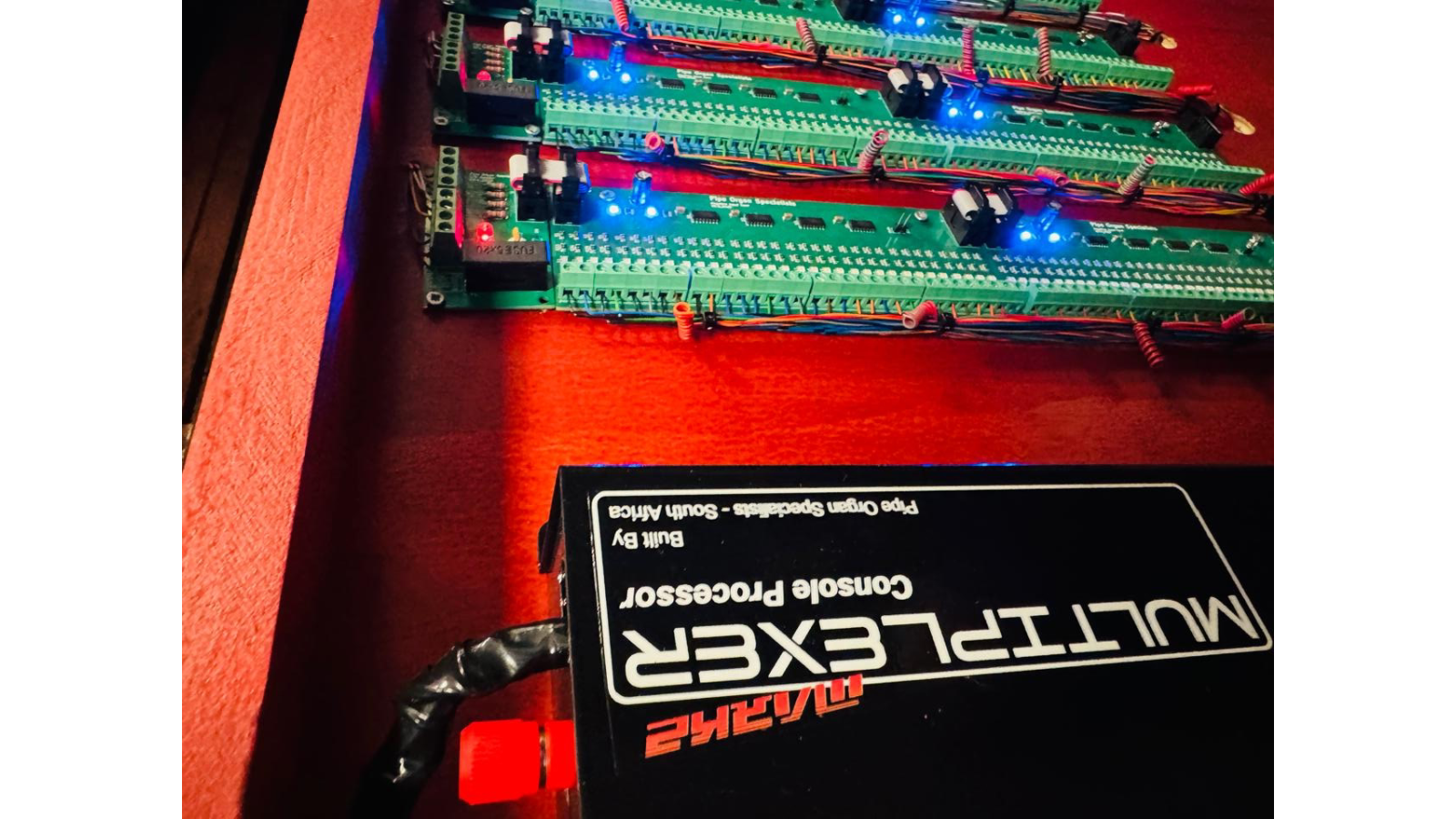
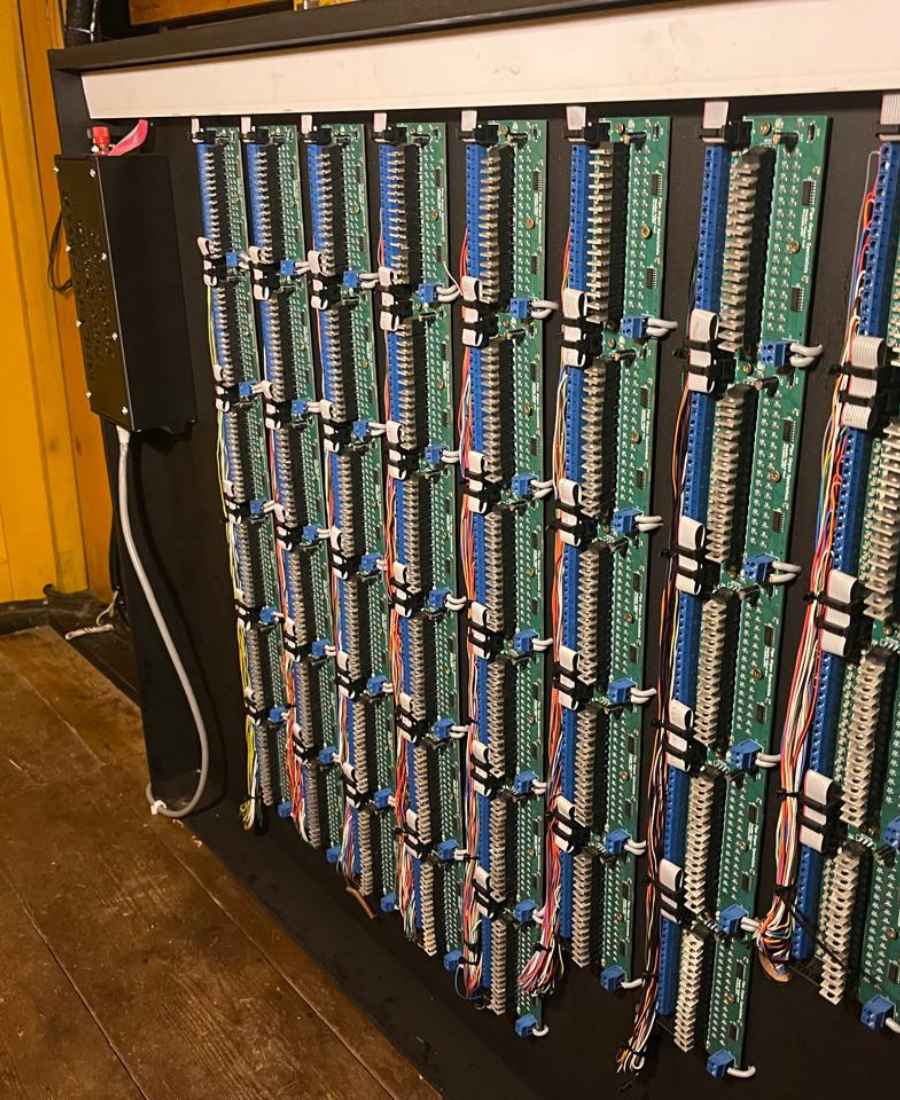
The input and output cards have LEDs per channel for easy diagnostics if an input is being registered (input card) or an output to a magnet is on/off. (Output card). The console and chamber processors have software firmware versions that can be upgraded if required making the system flexible for future expansion of the organ.

The system uses a standard RJ45 10/100mb per second networking Ethernet cable to interface the console and chamber up to 100 meters apart. This is the only cable required between the console and the chamber. The present capture system saves the data to a built in SD card.

The Multiplexer interfaces with unique external PC/laptop (your preference) software (via simple USB cable) that records and plays back the actual pipe organ. (Not via speakers). All recordings can be saved and recalled. You can also edit the MIDI tracks adding and removing stops after the fact. You can play your favourite MIDI track downloaded off the Internet.

The system can handle the less overhead slider control organs but also the most complex of unison organs that share ranks and have many more magnets to control.

The system is all locally designed and assembled and comes with a full 3-year guarantee. Our test organ “Nigel” has been played by many an organist to ensure zero errors and an electronic system that will never let you down. The system was developed and tested over many years by Pipe Organ Specialists and we would welcome to chat to you and provide a solution for your unique pipe organ.
Innovation Highlights

  • The console no longer uses high voltages or high-current switching, eliminating sparks that cause carbon residue on contacts and lead to faulty operation.
  • Modern switch-mode power supply with advanced protection features including under-current, over-voltage, and short-circuit protection.
  • Outdated selenium plate rectifiers are eliminated, removing a known fire hazard and replacing them with protected modern electronics.
  • Significantly reduced wiring inside the console, minimizing fault points and improving long-term reliability.
  • High-speed networking between the console and pipe chamber eliminates extensive cabling and allows the console to be mobile.
  • Input and output cards are built using robust, modern technology for dependable performance.
  • Optional playback system records and replays performances directly through the organ pipes.
  • Complete system supplied with a full 3-year guarantee.

Old Riser Board vs. Digital Multiplexer

Old Riser Board Technology

The Old Riser Board System

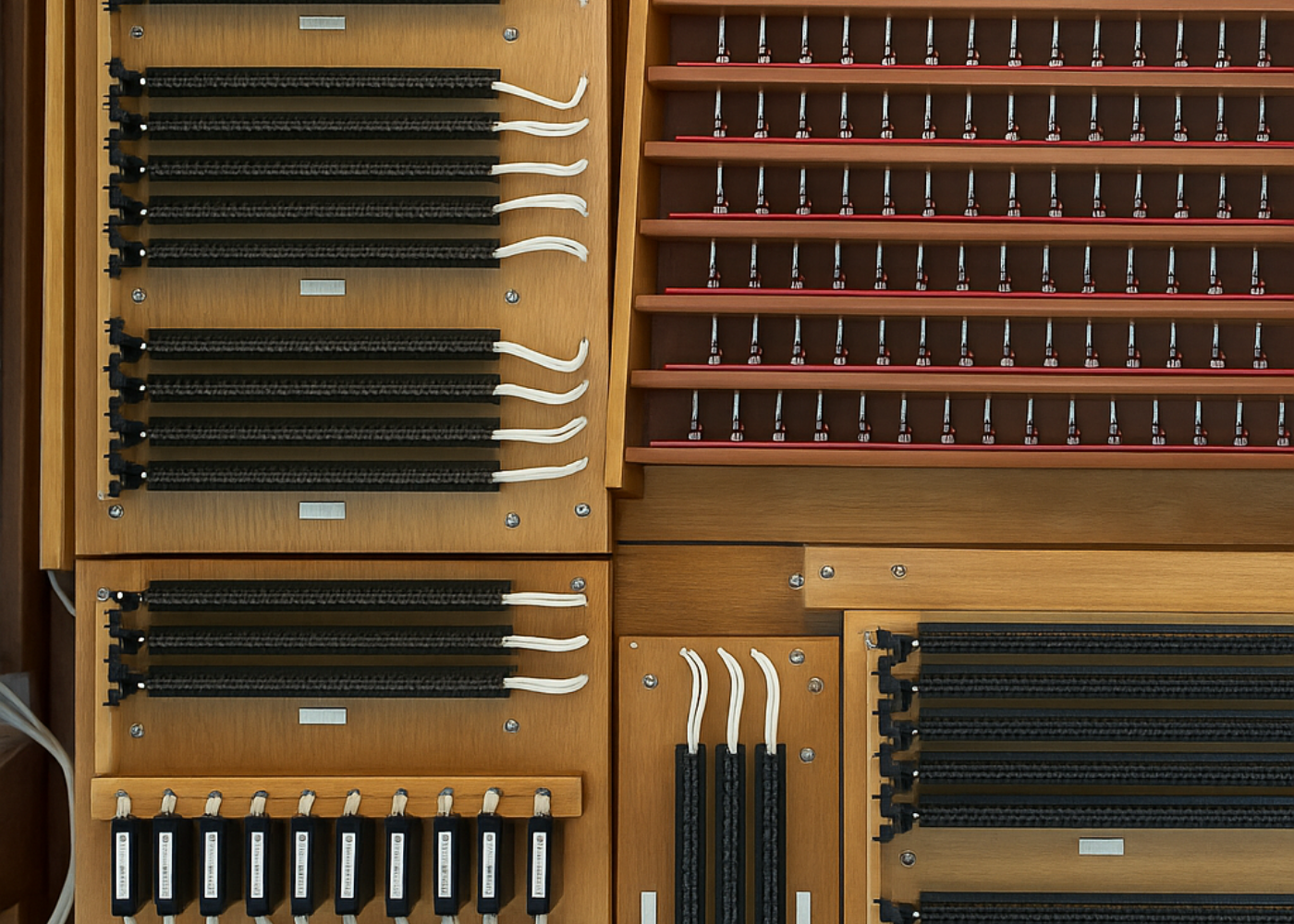
Traditional pipe organ control depended on riser boards: bulky panels of relays, contact switches, and resistors. These had to route signals from the console through physical contacts to trigger each pipe valve.

Hundreds or even thousands of individual wires ran between the console and chamber — one for every key, stop, or coupler. Troubleshooting or modifying these wiring systems was time‑consuming and prone to error.

Over time, relay contacts wear out, solder joints fail, and connections corrode. These failures cause issues like dead notes, crackling noises, and intermittent faults — frustrating problems for any pipe organ performer.

Digital Multiplexer System

The Digital Multiplexer Revolution

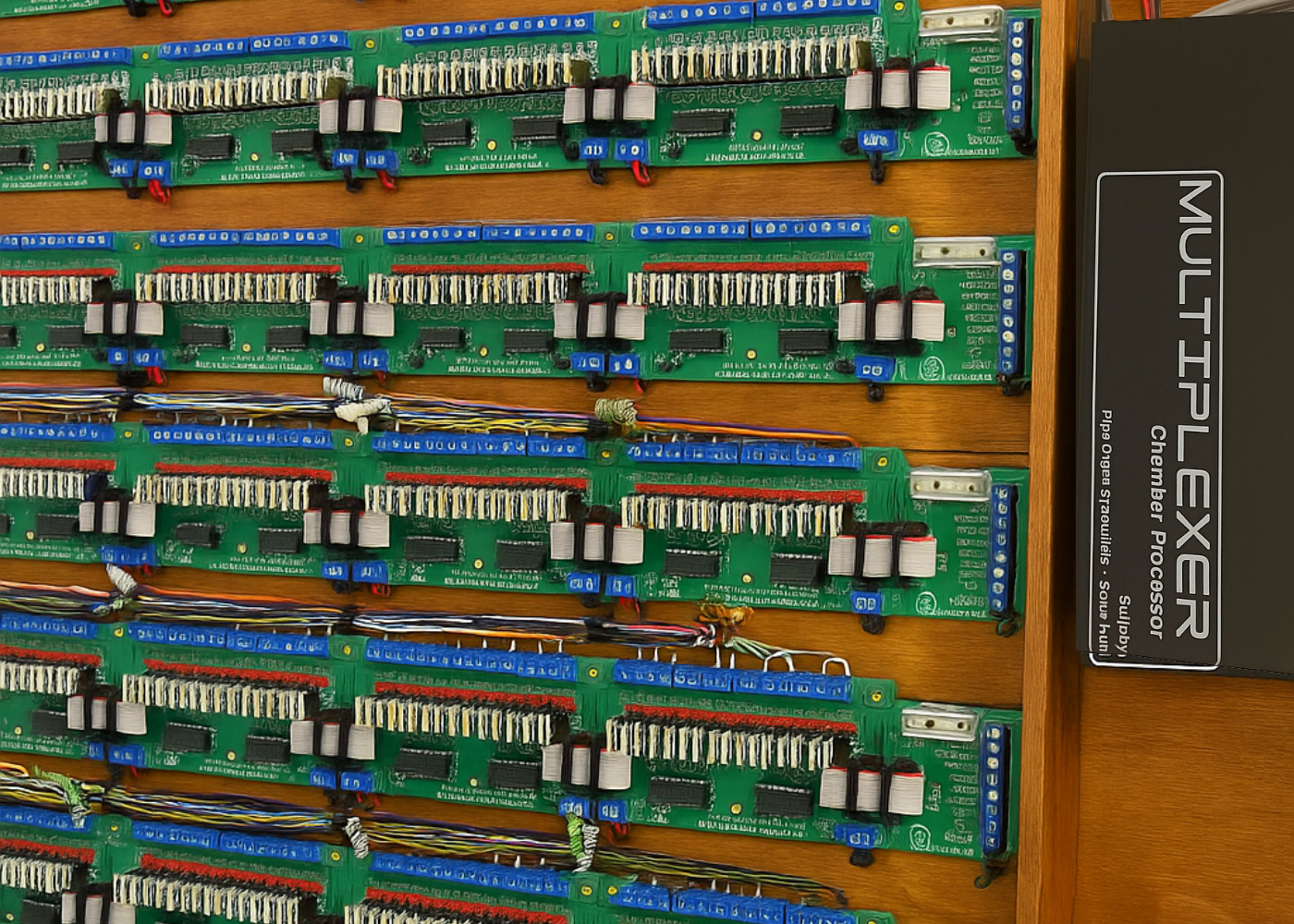
The MK2 Multiplexer replaces all that complexity with a modern, pipe organ–friendly design. Instead of thick looms of wires, it uses a single high-speed digital connection — Ethernet or Wi‑Fi.

The console sends digital commands to controller boards in the pipe organ chamber. These boards then drive MOSFET switches to fire the pipe valves — no mechanical relays, no noisy contacts, no wearing-out parts.

That means your pipe organ performs silently and instantly. You get reliable operation, and changes like adding stops don’t require complex rewiring — just software updates on the MK2 Multiplexer.

The MK2 Multiplexer also supports key features you can’t get with riser boards: unlimited memory combinations, performance recording, MIDI integration, and remote control — all while reducing maintenance and saving installation time.

Explore Our Products

Advanced Solutions for Modern Pipe Organ Systems

Negative Input Card

A 32-channel board that efficiently reads multiple negative-logic console inputs from manuals, pedal board, registers, and pistons. Employs high-speed parallel-to-serial conversion with input conditioning and de-bounce features. Per-channel LED indicators enable instant diagnostics, while daisy-chain expansion allows multiple cards to share the same serial bus for scalable installations.

Expression and Crescendo Module

Provides precise potentiometer-based control supporting up to 10 crescendo stages and 14 expression stages. Delivers low-latency, reliable outputs with configurable response curves (linear, logarithmic, or custom). Functions standalone or integrates seamlessly with Multiplexer systems for centralized operation and preset-driven dynamics.

Free Combination Module

Compact standalone registration controller with serial peripheral connectivity for HMI screens and external devices. Accepts four main inputs and drives four high-current outputs (HR and VK1-VK3). Designed as a direct replacement for failing analogue VK systems, bringing modern control and simplified wiring to vintage and contemporary instruments.

Standalone Multiplexer Preset System

Self-contained preset engine offering 100 memory levels for complete stop and coupler configurations. Features a high-resolution touchscreen for fast memory selection and clear visual confirmation. Plug-and-play standalone operation with no external computer required, ideal for rehearsal, recital, and liturgical use.

Slider Motor Control Card

Digital control card operating at 12-24V that drives wiper motors and solenoids using a solid-state full H-bridge. Includes comprehensive protection suite: short-circuit, reverse-polarity, over-current, thermal shutdown, and back-EMF handling. Status LEDs provide instant diagnostics for accurate, safe motor actuation in slider action systems.

Signal Converter and Amplifier

Chamber-mounted interface using high-speed MOSFET switching to translate console signals into robust drive for pipe-chamber solenoids. Features polarity conversion, level shifting, and per-channel LED diagnostics. Removes direct high-current switching from the console, protecting delicate contacts from carbon buildup and ensuring reliable operation.

Negative Output Card

16-channel MOSFET-based driver board engineered for high-current, low-latency switching of solenoids and inductive loads. Features low-Rds(on) N-channel MOSFETs, per-channel LED indicators, and integrated flyback suppression. Daisy-chainable for scalable installations, designed for chamber or relay cabinet mounting to minimize high-current cable runs.